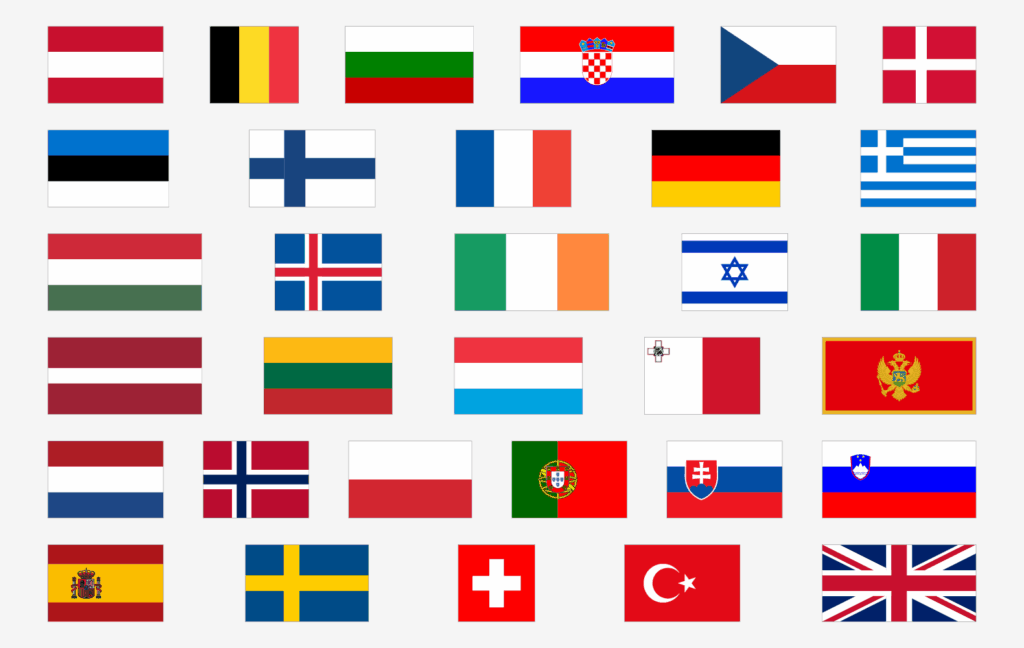
The 2025 EMBC plenary meeting took place at in Heidelberg on 24 November. Founded in 1969, the EMBC is the inter-governmental organization comprising 32 member states that funds the EMBO Programmes. EMBC Delegates are nominated by the governments of the member states. Typically, each Member State appoints one delegate from a relevant ministry or funding agency and one scientific adviser. EMBC and EMBO also co-operate with countries and organizations beyond Europe – global partners – to foster interactions with international scientific communities.
Appointment of the EMBC Officers for 2026
The EMBC is led by a President, two Vice Presidents and a Secretary General. The Conference meets once or twice per year. The EMBC President is Nektarios Tavernarakis (Greece). Vice Presidents are Hemma Bauer (Austria) and Lovorka Barać Lauc (Croatia). The Secretary General is Mark Palmer (United Kingdom).
During the meeting, the EMBC Delegates Nektarios Tavernarakis (Greece) was re-elected for a second term as President of EMBC, Hemma Bauer (Austria) was re-elected for a third term as Vice President of EMBC and Lovorka Barać Lauc (Croatia) was re-elected for a second term as Vice President of EMBC. Mark Palmer (United Kingdom) was appointed for a second term as Secretary General of EMBC.
“I am deeply honoured by the trust placed in me through my re-election as President of the EMBC”, said Nektarios Tavernarakis. “Working alongside Vice Presidents Hemma Bauer and Lovorka Barać Lauc, and Secretary General Mark Palmer, we will pursue our shared mission to advance excellence in molecular biology, in Europe and beyond. I look forward to continuing this fruitful collaboration as we further empower scientific talent across our Member States. Together, we will build on EMBC’s achievements and foster an environment where discovery and innovation can thrive.”
Leveraging the EMBO impact across Europe
EMBO Director Fiona Watt provided a summary of the EMBO activities for the last year, highlighting achievements in the five areas of work and their impact on scientist’ career development and the research system:
- Membership and awards, to recognize and catalyze excellence
- Programmes and schemes, to grow and connect talents
- Journals, courses and training, to accelerate knowledge-dissemination
- Policy and innovation, to innovate the research ecosystem
- Governance and management, to maintain an effective organization fit for purpose.
Presentations included the Increasing Participation initiative that EMBO introduced in the period 2020–2024 to increase participation of scientists in EMBO Programmes and activities across the EMBC. In November 2024, EMBC decided that EMBO should continue working on Increasing Participation during the 2025–2029 period. Based on the experience and lessons learned from the first Increasing Participation initiative, the EMBO office presented proposals for action in the different funding schemes and activities.
Financial matters
In line with the governance calendar, a session of the November EMBC meeting was fully dedicated to financial matters, including the presentation of the Accounts for 2025 and external auditors report, report from the EMBO Finance Committee, and approval of the draft budget for 2026.
The Finance Committee advises the EMBC on all matters concerning the management of financial funds and on all audit tasks, and formulates recommendations for the EMBC. During the meeting, the EMBC elected Margarida Amaral (Portugal) as the new chair and Jan Buriánek (Czechia) as vice chair of the Finance Committee for 2026.
Session on National Initiatives for Research Integrity
To take full advantage of the onsite presence of the EMBC Delegates, this year’s EMBC meeting included an extra session to raise awareness and build collaboration on topics that resonate with the EMBO mission of promoting excellence in the life sciences. This year’s session focused on research integrity, an area in which EMBO has been working with life scientists to embed research integrity principles in their work, and create environments in which research is pursued responsibly, with integrity and to the highest standards.
The session included examples of national structures in two EMBC Member States, Austria and the UK:
Jane Alfred introduced the work of the UK Committee on Research Integrity, a government-initiated group established to promote cross-sector collaboration and providing an evidence base for research integrity actions in the UK, and Sabine Chai presented the work of the Austrian Agency for Research Integrity, created by Austrian universities and research institutes to develop guidelines, offer training, provide advice, and conduct investigation in case of alleged research misconduct.
Thanks to the engagement of the EMBC Delegates, the discussion addressed several key aspects of Research Integrity. These included the impact of mandatory training for all researchers, the implementation of sanctions, the interplay between laws, regulations, and guidelines, the translation of codes and guidelines into everyday research practice, and the impact of AI on research. The discussion also highlighted the need to rethink research assessment, moving away from an overreliance on publication metrics towards better recognition of trustworthy, rigorous and ethical research.
EMBO Director Fiona Watt said: “I am very grateful to all our EMBC delegates for their support. I am pleased that the session on Research Integrity was a success and would be delighted to receive suggestions for future discussion topics.”
Next meeting of the EMBC
The 57th meeting of the EMBC will take place on 23 November 2026 in Rome, Italy.