
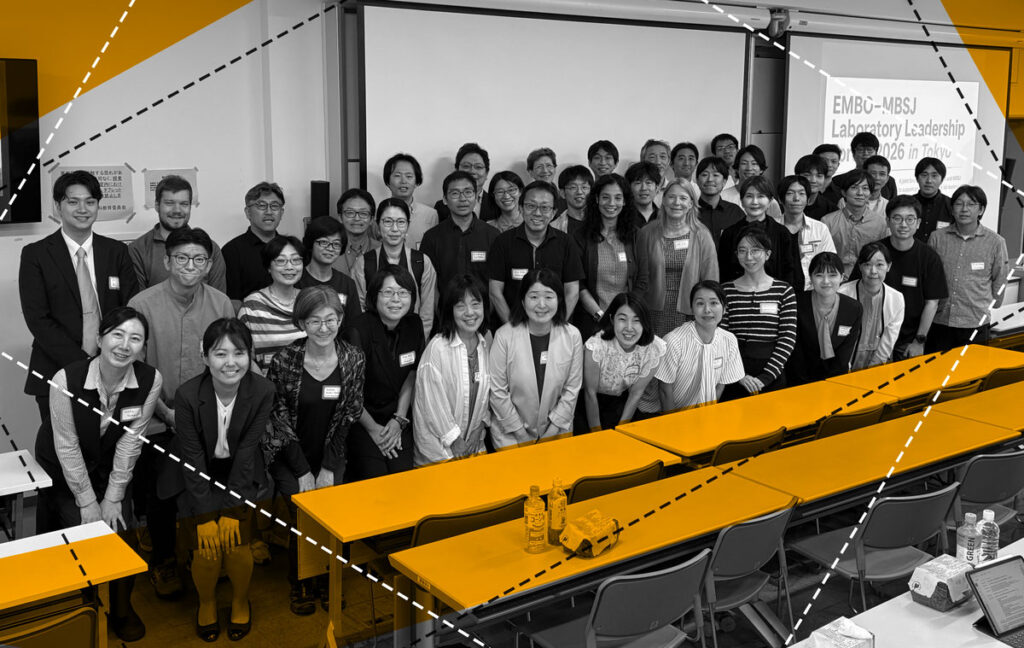
How can early-career researchers become effective research leaders? This question was at the heart of the fourth EMBO–MBSJ Laboratory Leadership Forum, held on 27 June in Tokyo and jointly organised by EMBO, the Molecular Biology Society of Japan (MBSJ), and the JST FOREST Programme. Bringing together international speakers and researchers from across Japan, the Forum provided a unique platform to exchange experiences on laboratory leadership, mentoring, communication skills, and career development.
The day opened with a keynote lecture by Susan Gasser (ISREC, Tohoku University, EMBO Member), who explored the changing role of scientific leadership and highlighted why leadership skills are increasingly recognised as an essential component of research excellence.
Following this, EMBO Consultant in Japan, Iris Wieczorek, presented an overview of the close partnership between EMBO and the Japan Science and Technology Agency (JST). She introduced the portfolio of opportunities available to JST-funded researchers through this collaboration, including the EMBO Young Investigator Programme, the EMBO Global Investigator Network, EMBO Fellowships, EMBO Courses & Workshops, JST travel grants for participation in EMBO Events, and participation in EMBO Laboratory Leadership Courses for group leaders in Heidelberg.
Drawing on experiences from previous EMBO Laboratory Leadership courses organised by EMBO Solutions in Japan, including at the University of Tokyo and RIKEN, Wieczorek shared key lessons learned and introduced participants to the concept of Sustainable Research Leadership. Addressing questions such as What makes a good research leader? Is every manager a leader? and Does every leader have to be a manager? she encouraged participants to reflect on the leadership skills required to build successful, inclusive, and resilient research environments.
The programme also featured perspectives from the Max Planck Institute, Academia Sinica, and RIKEN, showcasing different institutional approaches to leadership development. During the JST FOREST Luncheon Forum, researchers reflected on the career challenges they had faced and how they had overcome them. Among them was Reina Komiya of RIKEN, who described how her participation in a previous JST–EMBO Matchmaking Workshop led to a successful research collaboration with a European partner, illustrating the strong impact of international networking initiatives.
Part of the event was dedicated to interactive World Café discussions, facilitated by Wieczorek and members of the event’s organising committee. Participants exchanged experiences and discussed practical solutions on topics ranging from mentoring and recruitment to communication, time management, research strategy, and the responsible use of AI. Presentations and discussions reinforced the Forum’s overarching objective: supporting the next generation of research leaders through international exchange, peer learning, and practical leadership development.
For more information about opportunities available to JST-funded researchers through this collaboration visit embo.org/about-embo/global-activities/japan/.