
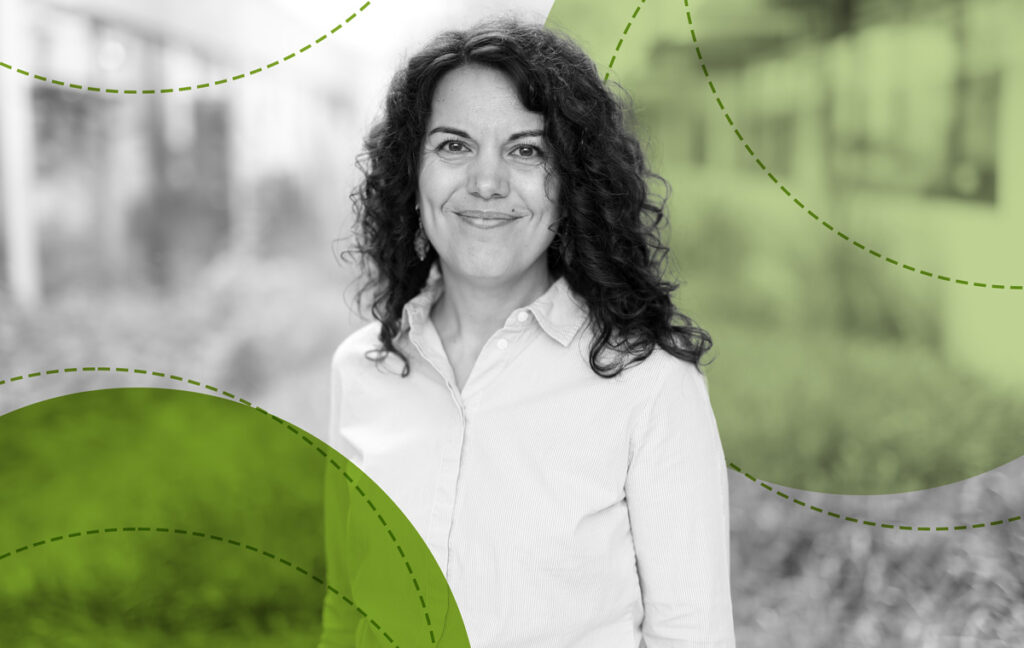
Danny Nedialkova is hopeful that Bulgaria’s membership of the EMBCwill provide opportunities for her and other Bulgarian researchers to reconnect with their home research environment. “Many of us have a desire to reconnect but we lacked the mechanisms to do so,” she says. “Personally, I have benefited from EMBO tremendously. It has been absolutely a game changer for my career.”
Nedialkova attended one of Bulgaria’s language high schools and studied science in English before starting her undergraduate degree in Biotechnology in Sofia. She took advantage of her university’s participation in a ‘European First Level Degree’ programme to finish her degree in Italy. “The programme was organized and run by the University of Perugia but the University of Sofia was one of the 12 European universities that jointly awarded our degrees,” she says.
Erasmus internships in Poland and the Netherlands further broadened her horizons and she returned to the Netherlands for her PhD in molecular virology at Leiden University studying the role of different proteins in viral replication. “I was working with viral RNA, and I always enjoy working with RNA because it is incredibly versatile and can do all these things that DNA cannot,” Nedialkova says. However, the global financial crisis hit at the end of her PhD, leading to funding cuts for science in many countries.
For research and family reasons Germany beckoned. “Germany was going in the other direction and spending more on research,” she says, adding that the move brought career lessons she now passes on to her junior lab members. “I had been only interested in doing science during my PhD and no one had told me about the strategic career advantages of moving to a prominent research institute with state-of-the-art facilities.”
Nedialkova’s postdoctoral supervisor at the Max Planck Institute of Molecular Biomedicine in Münster encouraged her to apply for the EMBO Postdoctoral Fellowship but she had just six weeks to prepare her proposal. “The Fellowship requirement to switch fields from the PhD to the postdoc is very often discouraged but in my case it was absolutely transformative,” she says. “The Fellowship is a stamp that you are working on an important and exciting project.”
After six years in Münster, Nedialkova successfully applied for a group leader position at the Max Planck Institute of Biochemistry in Martinsreid, Germany, and then also applied for the EMBO Young Investigator Programme.
“Being a member of the EMBO postdoctoral community had been transformative and I could only imagine what being a young investigator might mean,” she says. “In a crowded research environment like Munich, it is very important to be able to attract the best trainees, and the programme gives you visibility. The timing was a bit tricky because I had to write the full EMBO application as a new mom with a two-month-old at home.”
Nedialkova says joining the Young Investigator Programme has fostered new connections and collaborations for her and also helped her trainees through attendance at the EMBO PhD course and funding to attend conferences.
Nedialkova is studying how translation is regulated differently in different cell types and states. “We very often think of translation as a housekeeping process that works much the same way in every cell, but obviously every cell has a completely different proteome and during development and differentiation you have very different global translation rates,” she says. “We know very little about how all of this is regulated.”
Nedialkova says the RNA research community is very open-minded, sharing questions, data and constructive criticism. “At the EMBO 60th Anniversary event in 2024 I could have conversations at dinner about whether we were using the right methods for a question and the person next to me could say ‘let’s team up’,” she says.
She is excited by the potential therapeutic benefits arising from her research field. “There are people designing tRNAs to suppress premature stop codons that account for 10% of monogenic diseases. If you can trick the ribosome into reading through it could have a tremendous therapeutic benefit,” she says. “I am trying to understand what makes a tRNA a well-functioning tRNA. This is absolutely essential if you want to design a tRNA and so my work is very complementary to these focused approaches.”


