Launched in 2019 at the ASCB/EMBO Meeting in Washington DC to make scientific publishing more open and effective, the preprint peer review platform continues to expand. Today, authors, reviewers and editors who engage with Review Commons are scientists who want to benefit from and contribute to a more transparent and rational way of communicating their research.
Thomas Lemberger, lead of the Review Commons initiative, tells us more about the platform’s journey and the people who made it possible, from its creation to the goals ahead.
What was the core idea that inspired the creation of Review Commons?
A core idea was to add public peer review to preprints, providing the essential layer of expert scientific evaluation that would strengthen the trustworthiness of preprints while maintaining their openness. Crucially, the peer review process would be carried out before journal submission and, therefore, without the need to evaluate a study’s fit with a specific journal in terms of scope and editorial level of selection, which has historically been “lumped” into the peer review process. This was the essence of the concept of “journal-agnostic” peer review, which fundamentally decouples scientific assessment from editorial selection, as articulated by Ron Vale, Tony Hyman and Jessica Polka in their “Peer Feedback” proposal presented at the ASAPbio meeting in 2018.
The second motivation for Review Commons was to eliminate redundant cycles of peer review. In the classical publishing system, when a paper is rejected after peer review by a journal, authors must start afresh by submitting to another journal and undergo peer review with a new set of referees. This leads to massive inefficiencies, both for authors, who lose time, and for reviewers, who are bombarded with requests from journals competing for the same pool of reviewers. Review Commons was therefore set up to ensure that its journal-agnostic peer review stays fully journal-compatible, allowing authors to quickly find a home for publishing their studies.
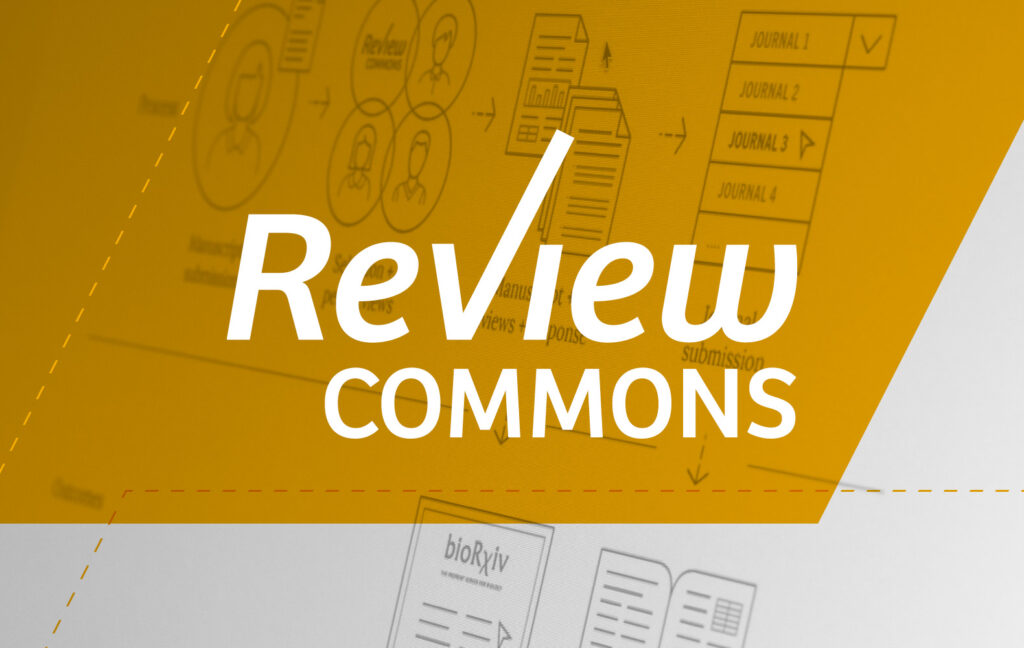
Combining these two ideas on a single platform allows Review Commons to serve authors by providing high-quality, transparent peer review of submitted preprints, which can then be transferred directly to affiliated journals without undergoing new peer review. The best of both worlds!
The genesis of the platform went through many iterations, through a remarkably collective process involving many people, including Jessica Polka, Ron Vale from ASAPbio, Veronique Kiermer from PLOS, Mark Patterson from eLife and Maria Leptin, Bernd Pulverer and me at EMBO. The initial small group of pioneering publishers has now been expanded to 29 journals across 13 publishers.
Review Commons was implemented at EMBO thanks to the full commitment and support of Bernd Pulverer, Head of EMBO Press, and the editorial teams of the EMBO Journal, EMBO Reports, Molecular Systems Biology, and EMBO Molecular Medicine. Finally, the energy and dedication of Sara Monaco, Review Commons’ managing editor, and Ruby Ponnudurai, Scientific Editor, have been vital to keep the platform running and engage with the community, liaising with authors and participating in panel discussions, webinars, and lab visits.
What are the future developments for Review Commons?
There is very strong support for Review Commons from the scientific community. We are energized by the growing number of scientists, publishers and editors who embrace reviewed preprints. One of the key steps now is to persuade institutions and funders to credit reviewed preprints for research assessment and hiring decisions. The tyranny of the “publish or perish” culture is demotivating for the young generation of researchers. It is our responsibility, as a global scientific community, to reform the current legacy evaluation system, which is overly influenced by brand name and flawed metrics.
Leading by example, EMBO recognizes reviewed preprints in its eligibility criteria for applicants to its prestigious Young Investigator Network and Postdoctoral Fellowships. More efforts are needed at the institutional level, where reviewed preprints still have to make their way in hiring decisions and career progression assessments.
One recent significant development is the participation of several editorial teams, in addition to EMBO Press, to run the peer review process on behalf of Review Commons. This process was piloted by academic editors of Development and Journal of Cell Science and has now been extended to editors in the field of neuroscience (eLife), genetics and genomics (Genetics and G3) and further depth in cell and molecular biology (Journal of Cell Biology). This is especially noteworthy since journals traditionally compete for authors and reviewers and it shows how Review Commons can catalyze change together with like-minded publishers. Authors can now benefit from the combined expertise of multiple editorial teams.
With the full support of Fiona Watt, EMBO Director and of EMBO as an organization, Review Commons is looking forward to expanding its scope further and engaging with our communities to affirm the impact of reviewed preprints in scientific communication and assessment. Scientific communication is entering an incredibly exciting yet uncertain phase with AI’s major impact on all aspects of the scientific process. With the rise of AI-based scientific review platforms, the role of human peer review might change in the future, maybe in a profound way. Review Commons and EMBO Press are therefore exploring in a careful yet proactive way how AI can synergize with researchers to improve the quality of published science while reducing the burden on authors and reviewers. I anticipate that in a world where AI is pervasive, the role of human-to-human feedback and community exchange and recognition will be more vital than ever. Fostering these interactions is where I see the future of Review Commons and scientific journals. The future will tell…
Read more: reviewcommons.org
Get in touch: