Moving from Japan to Europe opened new opportunities for Yusuke Azuma. As he says, “I was young enough not to be concerned” – though he knew that maintaining connections with the Japanese research community could be challenging. Azuma left Japan at the end of his PhD, moved to Switzerland for a postdoctoral position, and later established his own group at the Malopolska Centre of Biotechnology, Jagiellonian University, in Krakow. More than a decade on, he has built a strong research network in Europe – but connections with Japan remain important to him.
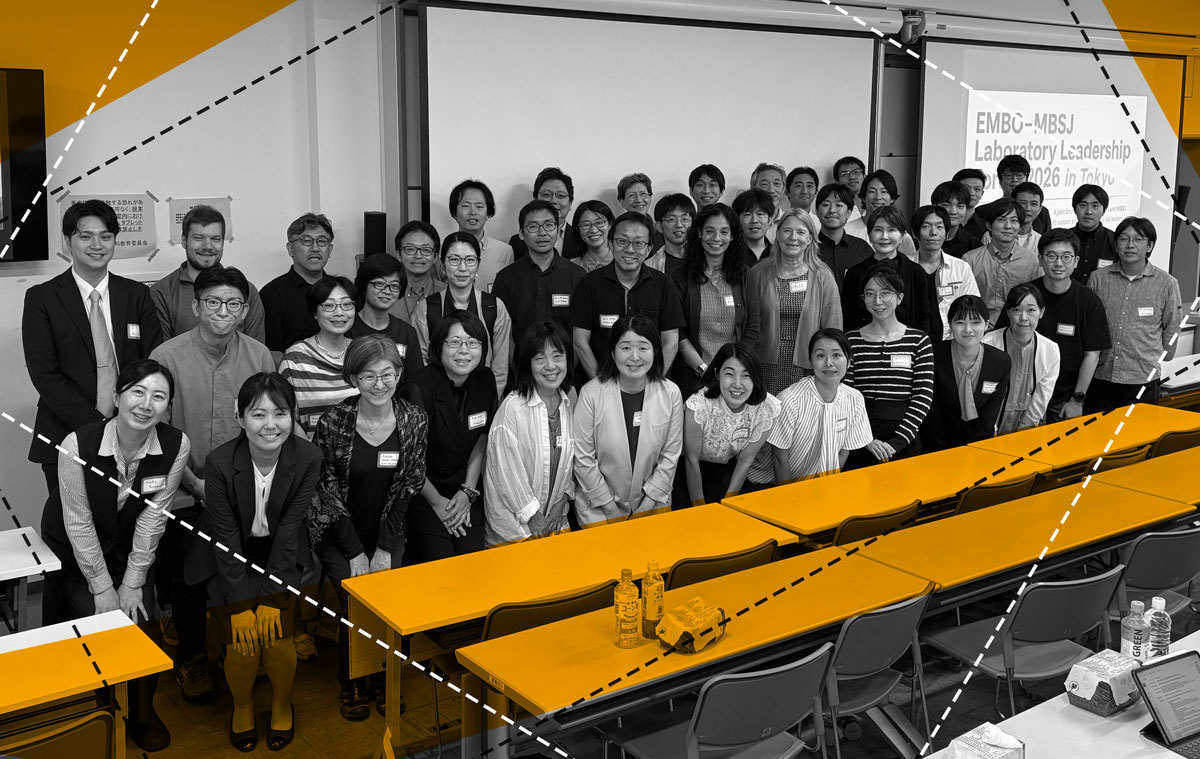
A networking workshop in March 2023 in Tokyo gave him an opportunity to reconnect. Jointly organised by EMBO and JST (Japan Science and Technology Agency), the workshop marked the launch of a lasting formal collaboration between the two organisations, which has since grown to encompass Fellowships, the Young Investigator Programme, EMBO Lab Leadership Training and further conferences and workshops, all aimed at strengthening bridges between the scientific communities in Europe and Japan.
Azuma arrived with a very specific person in mind. “I was targeting him,” he recalls. Through the workshop programme, he had identified Takahiro Kosugi, a computational scientist at the Institute for Molecular Science in Okazaki (currently affiliated with Kanazawa University), whose expertise could complement his own work in structural biology. Rather than simply sending an email, Azuma wanted to meet him in person first.
That meeting became the starting point for a collaboration combining experimental structural biology with computational simulations, ultimately contributing to the paper A molecular basis for stoichiometric enzyme encapsulation in the vitamin B2 biosynthesis compartment, published in Nature Communications in May 2026.
Bringing different expertise together
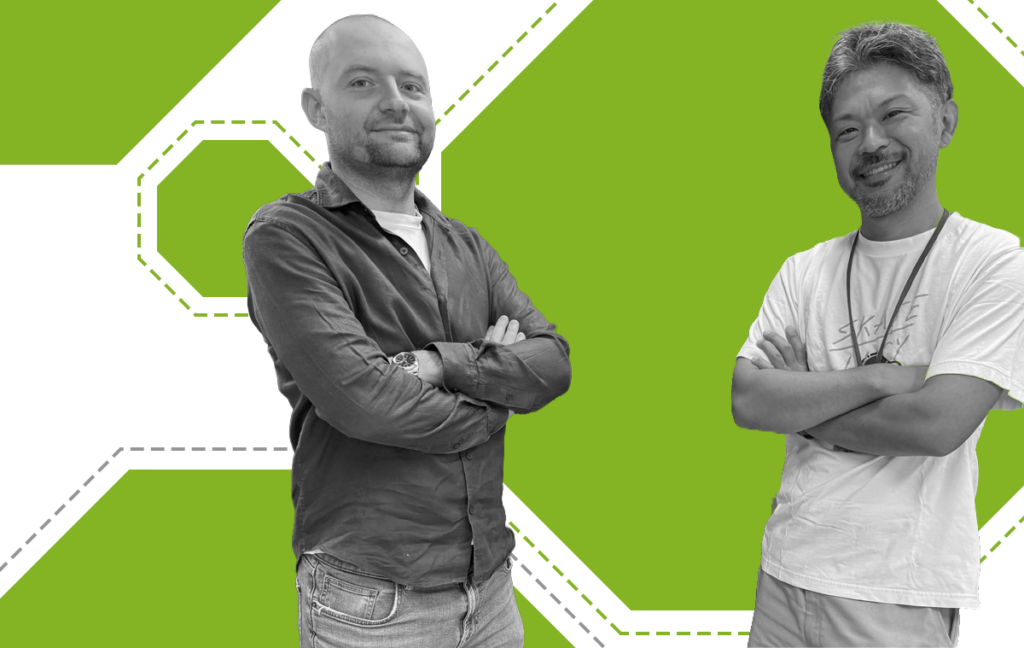
The story is about how research relationships are built over time. Lukasz Koziej was the first postdoctoral researcher Azuma hired in Kraków. When Koziej later became independent, the two stayed in contact – a relationship that provided an important foundation for the project bringing together Azuma, Koziej and Kosugi.
The scientific question suited their complementary expertise. Azuma’s group studies protein compartments: shell-like structures that package enzymes and enable vitamin production. Using cryo-electron microscopy, the researchers captured the molecular mechanism behind this compartmentalisation – but the data raised further questions that computational simulations could help answer. Working with Kosugi, Azuma’s team used computational modelling to explain their experimental observations and investigate why certain reaction pathways cannot occur.
Azuma enjoyed communicating with Kosugi in Japanese after years of working predominantly in English. Familiar with the conventions of Japanese research, he didn’t need to navigate them as an outsider – a familiarity that helped build ease and trust. He particularly valued Kosugi’s sense of responsibility and reliability, qualities he considers essential to a successful collaboration.
For Koziej, working with a researcher in Japan opened a door to a scientific community he’d had little chance to access before. He noted that Japanese research groups are often organised around a single principal investigator leading a large team, which makes it harder for outside collaborators to find the right person to contact. “So it is a very crucial question of ‘whom to approach'”, he explains.
The team also benefited from the advanced cryo-electron microscopy facilities at the National Synchrotron Radiation Centre, Solaris, in Krakow. Good access to the cutting-edge instrument, less readily available in Switzerland and the UK, where Azuma and Koziej had been working, drew them both to Poland.
From a conversation at a workshop to an unexpected discovery
The main discovery of the collaboration work was not something the researchers had anticipated when they first connected. A key moment came with identifying a previously unknown structure: combining experimental data with computational analysis let the team not only observe it but understand its functional significance.
For Koziej, this discovery was central to the project’s impact. For Azuma, the experience underscored the value of combining complementary expertise – and of finding the right person at the right moment.
The collaboration is set to continue, with future computational projects set to benefit from the working relationship the researchers have built. “It has become much easier to collaborate,” Koziej notes, adding that he would approach Kosugi again.
More than a meeting
The experience shows what international networking can achieve when a workshop yields more than a collection of new contacts – though researchers still need to find common ground, build trust, and develop a way of working together from that initial connection.
For Azuma, the workshop reconnected his European career with the Japanese scientific community. For Koziej, it opened a door that would otherwise have stayed closed. For all three, one carefully chosen conversation grew into a collaboration that reached all the way to answering a fundamental scientific question.
This illustrates why international networking matters particularly for researchers who have moved abroad: while geography often makes collaboration easier within Europe, meaningful links with researchers in Japan remain valuable precisely because they take more effort to sustain.
The EMBO–JST workshop provided the bridge. What the researchers built on it – a partnership spanning continents and disciplines – shows just how far a single conversation can go.